Jul 21, 2026
Instagram, Human Psychology, and the Hidden Cost to Mental Health
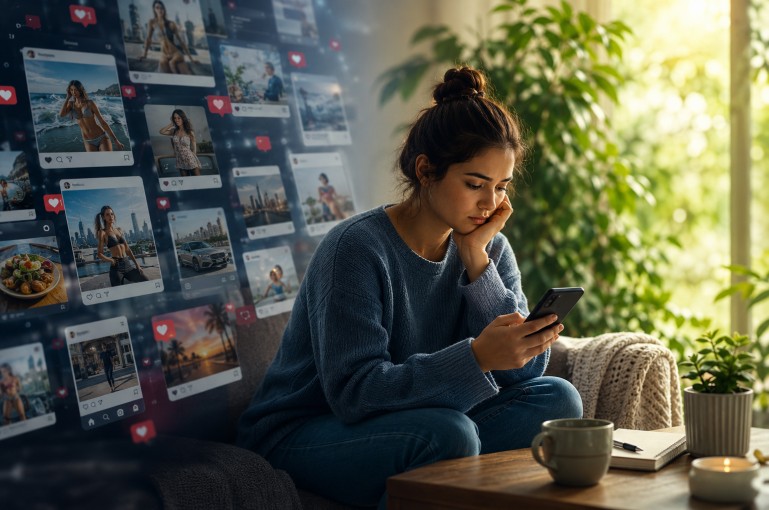
Discover how Instagram affects mental health through social comparison, digital overload, attention fatigue, and emotional well-being.
When people discuss Instagram and mental health, the conversation often revolves around anxiety, depression, addiction, low self-esteem, or excessive screen time. While these concerns are important, I believe the deeper issue lies elsewhere. From my perspective, the challenge is not Instagram itself but the interaction between modern technology and the human nervous system.
The human brain evolved for a very different world than the one we inhabit today. For thousands of generations, human beings lived in relatively small communities, spent significant time outdoors, engaged in physical activity, maintained close social bonds, and experienced life directly through their senses. The emotional and motivational systems that shape our wellbeing evolved within these environments. However, within a remarkably short period of history, digital technologies have transformed how we communicate, work, learn, and relate to one another.
Instagram represents one of the most powerful examples of this transformation. In a matter of minutes, a person can be exposed to hundreds of faces, lifestyles, opinions, achievements, relationships, advertisements, and emotional experiences. The brain receives an enormous volume of social information, far beyond what it was naturally designed to process. Although we consciously understand that we are viewing a digital platform, deeper emotional systems within the brain often respond as though these experiences are part of our immediate social environment.
I do not see this primarily as a problem of willpower. Rather, it is a consequence of a biological system encountering a level of stimulation for which it was never prepared. The nervous system evolved to process direct human experiences, not endless streams of rapidly changing digital content. As a result, many individuals find themselves mentally stimulated yet emotionally exhausted.
The Human Brain Was Never Designed for Constant Digital Stimulation
One of the most significant psychological consequences of Instagram is social comparison. Human beings naturally compare themselves with others. This tendency is not a flaw; it is part of our evolutionary heritage. Historically, however, people compared themselves with a relatively small number of individuals within their communities. Today, a person may compare themselves with thousands of people every week. They compare their appearance with models, their careers with entrepreneurs, their relationships with influencers, and their lifestyles with carefully curated portrayals of success.
The problem is that people are often comparing their everyday reality with someone else's highlight reel. Over time, this can create feelings of inadequacy, dissatisfaction, self-doubt, and the persistent belief that life should somehow be different. Many individuals begin to feel unsuccessful despite achieving things that would have been deeply meaningful to previous generations.
Social Comparison and the Shift from Living to Watching
Another concern is the gradual replacement of direct experience with observation. Human wellbeing emerges through participation in life rather than merely watching life unfold. Yet increasingly, people spend hours observing others travel, exercise, celebrate, achieve goals, build relationships, and express emotions. The brain becomes accustomed to consuming experiences rather than creating them.
From an affective neuroscience perspective, human beings require exploration, play, curiosity, connection, care, purpose, and meaningful engagement with the world. These emotional systems evolved to be activated through real-world experiences. While social media can provide stimulation and entertainment, it cannot fully replace the neurobiological benefits of genuine human interaction, physical presence, nature, movement, and shared experiences.
I increasingly observe that many people are not suffering because they have too little information. They are suffering because they have too much information and too little lived experience. They know what thousands of people are doing, yet they feel disconnected from their own lives. They are informed about everything happening in the world, yet struggle to understand what is happening within themselves.
Information Overload, Attention Fatigue, and the Loss of Mental Stillness
Instagram also contributes to information overload. Every day, users are exposed to advice about relationships, health, fitness, parenting, business, spirituality, productivity, and personal growth. While much of this content may be valuable, the sheer volume of information can become overwhelming. The brain was not designed to process endless streams of recommendations and competing opinions. Instead of creating clarity, excessive information often creates confusion, uncertainty, and decision fatigue.
Another important issue is attention. Instagram is designed to capture and maintain attention through novelty, unpredictability, and continuous engagement. The brain becomes accustomed to rapidly changing stimuli. Over time, ordinary experiences such as reading a book, having a conversation, sitting quietly, or taking a walk may feel less stimulating by comparison. This can gradually reduce our capacity for sustained attention, reflection, and deep engagement.
Perhaps one of the greatest losses in the digital era is the disappearance of silence. Human beings need moments of mental stillness. Reflection, creativity, emotional processing, and self-awareness often emerge during periods when the mind is not occupied. Yet many people fill every available moment with scrolling. Waiting rooms, meals, travel time, and even the moments before sleep become opportunities for additional stimulation. The nervous system rarely gets an opportunity to recover.
Reconnecting with Real Life: The Future of Mental Wellbeing
This is why I believe the future of mental health will involve more than treating anxiety or depression. It will involve helping people reconnect with the experiences that support healthy human functioning. Face-to-face relationships. Meaningful conversations. Physical movement. Nature exposure. Purposeful work. Community. Reflection. Silence. These experiences are not luxuries. They are biological and psychological necessities.
Instagram itself is not the enemy. It is a tool. Like any tool, its impact depends on how it is used. The real question is whether social media is enriching our lives or gradually replacing the experiences that make life meaningful.
As we move further into the digital age, mental health may increasingly depend on our ability to manage attention, filter information, and maintain genuine human connection. The challenge of the future may not be learning how to spend more time online. It may be learning how to remain connected to ourselves while living in an increasingly connected world.
Perhaps the most important question is not how much time we spend on Instagram, but what we are missing while we are there. Because no digital platform, regardless of how advanced it becomes, can fully replace the experiences that the human brain and nervous system evolved to need. The future of wellbeing may depend upon our ability to rediscover those experiences and make space for them once again.
If you find that social media use is leaving you feeling anxious, emotionally drained, constantly comparing yourself to others, or disconnected from your own life, it may be helpful to speak with a mental health professional. At Softmind Wellness, our experienced psychologists provide evidence-based therapy and counselling to help individuals develop healthier digital habits, improve emotional well-being, manage stress, anxiety, and self-esteem concerns, and build a more balanced relationship with technology. Seeking support is not about giving up social media—it's about learning to use it in a way that supports, rather than diminishes, your mental health.