Oct 12, 2026
How Media Hype Shapes the Way We See the World
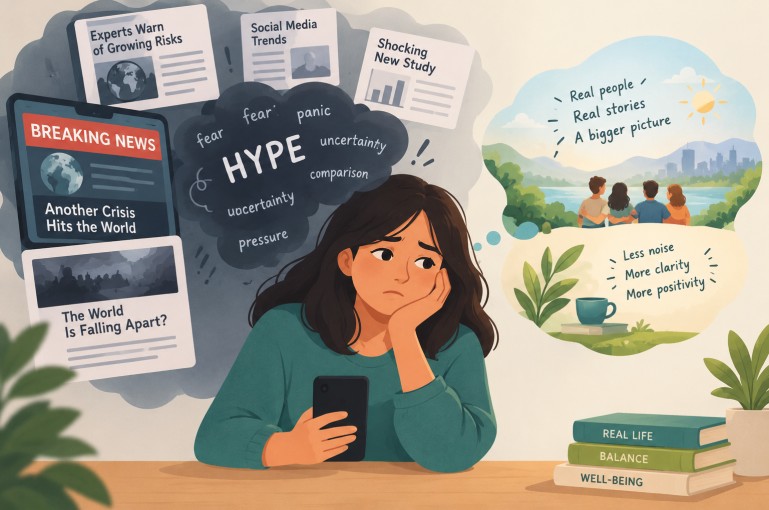
Why repetition, emotion and selective attention can influence what feels true, important and normal.
A short video appears on your phone. Someone looks angry. A caption explains why. The comments have already decided who is right.
Within seconds, you may feel that you understand the person and the situation. Yet you have seen only a fragment.
This is an everyday feature of contemporary media culture. News, entertainment, advertising and social media bring distant experiences close to us. They also select, arrange and repeat those experiences. What reaches us is a particular view of an event, often presented with an emotional invitation: admire this, fear this, condemn this.
Understanding media influence means looking at how our attention, emotions and judgements interact with what we encounter.
What receives attention begins to feel important
An issue that appears repeatedly across news programmes and social feeds can occupy a large part of our awareness. Meanwhile, other consequential issues receive little visibility.
Communication research describes agenda-setting as the influence of media emphasis on which issues audiences consider important. Framing concerns how an issue is presented and interpreted—for example, which details, explanations or perspectives receive emphasis. These processes can influence public perception without determining what every individual believes. Wiley Online Library
Consider a public disagreement. One account foregrounds a person’s angry expression. Another describes the circumstances leading to the exchange. Both may contain accurate details, but they offer different starting points for judgement.
The question is therefore larger than whether a clip is authentic. We also need to ask what happened before it, what has been omitted and whether the caption’s interpretation is supported.
Familiarity can begin to resemble truth
A claim appears in a video, returns in a forwarded message and is repeated by several accounts. Eventually, it feels familiar enough to seem credible.
Experimental research demonstrates an illusory truth effect: repetition can increase the perceived truth of a statement. One explanation is that familiar information becomes easier to process, and that ease can influence our judgement of accuracy. This is a tendency, not an unavoidable response to every repeated claim. PubMed
In everyday media use, this creates a particular difficulty. Several posts may appear to confirm one another while all drawing from the same unverified source. We have encountered the claim many times, but may still have only one piece of evidence.
Familiarity tells us that we have heard something before. Verification asks whether there is a sound reason to believe it.
Strong feelings can help a story travel
Anger, fear, admiration and moral concern make stories personally meaningful. A post may invite us to defend a group, condemn an injustice or protect someone we identify with.
In a study of messages about polarising political issues on Twitter, researchers found that moral-emotional language was associated with greater sharing, particularly within ideological groups. The finding concerns specific content and networks; it does not establish that emotional stories are necessarily false or that all audiences respond alike. pubmed.ncbi.nlm.nih.gov
Still, it offers a useful way to reflect on our own behaviour. Sometimes we share because we have checked the information. Sometimes we share because it expresses something we already feel.
Our emotional response deserves attention. It also deserves a separate question: What does the evidence establish?
A visible moment becomes an entire person
A celebrity makes an awkward remark. A stranger loses their temper. A contestant cries. Soon, a brief scene becomes a judgement about someone’s character.
The footage may show real behaviour. What it rarely provides is enough information to understand the whole person.
From a whole-person psychological perspective, behaviour needs context: the situation, relationships, previous events and patterns over time. A single public moment can be discussed without pretending that it reveals a person’s complete inner life.
This becomes especially important when psychological labels enter public conversation. Terms such as “narcissist,” “bipolar” or “traumatised” can make an interpretation sound clinical. A video clip or a series of online comments does not provide the assessment needed to establish such conclusions.
Mental health awareness benefits from accurate language. Careless labelling can turn that language into another way of dismissing people.
Visibility can shape our idea of a normal life
Media influence extends beyond news and controversy. The lives we repeatedly see can become reference points for beauty, success, relationships and happiness.
An audience may encounter carefully selected achievements, edited appearances and unusually dramatic experiences. Those images can then become the background against which ordinary life is judged.
The effects differ between people. Research on social media and well-being reports varied findings and often small average associations. Personal circumstances and the nature of the experience matter; digital spaces can offer support and connection as well as difficult comparisons. doi.org
My concern is with the comparison itself. A person knows the effort, uncertainty and disappointment within their own life, while seeing only the public surface of someone else’s. It is easy to forget that these are different kinds of information.
A feed is a selection. It cannot establish how most people live, how happy they are or what a worthwhile life should look like.
An informed pause protects judgement
Media can expose injustice, communicate science, create community and bring neglected experiences into public view. Its value makes careful engagement worthwhile.
Digital well-being includes noticing how we arrive at an opinion. Before accepting or sharing a striking claim, it helps to check the original source, distinguish observation from interpretation and look for genuinely independent evidence.
Sometimes the most accurate response is provisional: This concerns me, but I do not yet know enough to reach a conclusion.
That pause leaves room for both empathy and accuracy. We can take an allegation seriously while checking its basis. We can acknowledge harmful behaviour while avoiding unsupported claims about a person’s psychology.
At Softmind, our whole-person perspective encourages attention to the relationship between daily experiences and emotional well-being. When media use contributes to persistent distress, repetitive checking or difficult comparisons, psychological counselling can help someone understand the pattern and develop more workable boundaries.
What we see influences what we feel. What we feel can influence what we believe.
Between encountering a story and making it part of our understanding of the world, there is room to ask: What do I actually know?